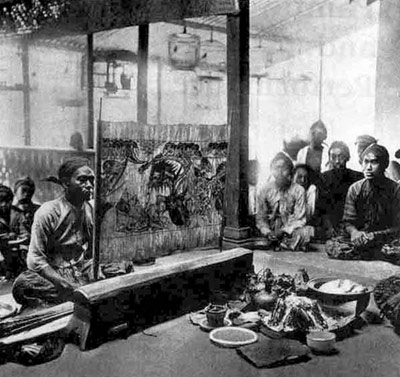
Wayang Kulit performances are an important accompaniment to traditional ceremonies, including weddings. They begin after nightfall and continue through the night, until just before sunrise. Shadow puppet performances relate religious stories, reinforce societal morals, and serve to entertain the public. |
The dalang, or puppet-master, may control several puppets by himself, or with the aid of an assistant on either side of him. The dalang may know over 100 stories, which he performs from memory. He is required to sit up to 6 hours without respite, perform voice acting in various inflections throughout his narration, and occasionally to sing – all while depicting ancient Hindu tales with his puppetry. Depending on the nature of the ceremony at which the Wayang Kulit is performed, there may be 4-40 musicians accompanying the performance. They are known as the gamelan. Various percussive instruments are used, including 2 drums symbolizing man and woman. Additional instruments may include metallophones, a gong, or flutes. The gamelan take cues from both the dalang, and the story itself, in order to add further emotion and emphasis to the stories. |
Two of the most common Hindu stories used in Wayang Kulit are the Mahabharata and Ramayana. The Mahabharata has upwards of 75,000 verses, and is over 1.8 million words in length. It is most certainly the longest known epic poem known. The poem plays a central part in explaining the Hindu values of karma, and the role of self in society. The title translates roughly to "the great story of the Baharata Dynasty". The Ramayana consists of 24,000 verses in seven books. It depicts duties and relationships, portraying archetypes like the ideal servant, the ideal brother, the ideal wife and the ideal king. These are two of the oldest and most important of the Sanskrit Epics from ancient India. |
 |
 |
| Home | About | History | Gallery | News | Links | Top of Page |